Overview
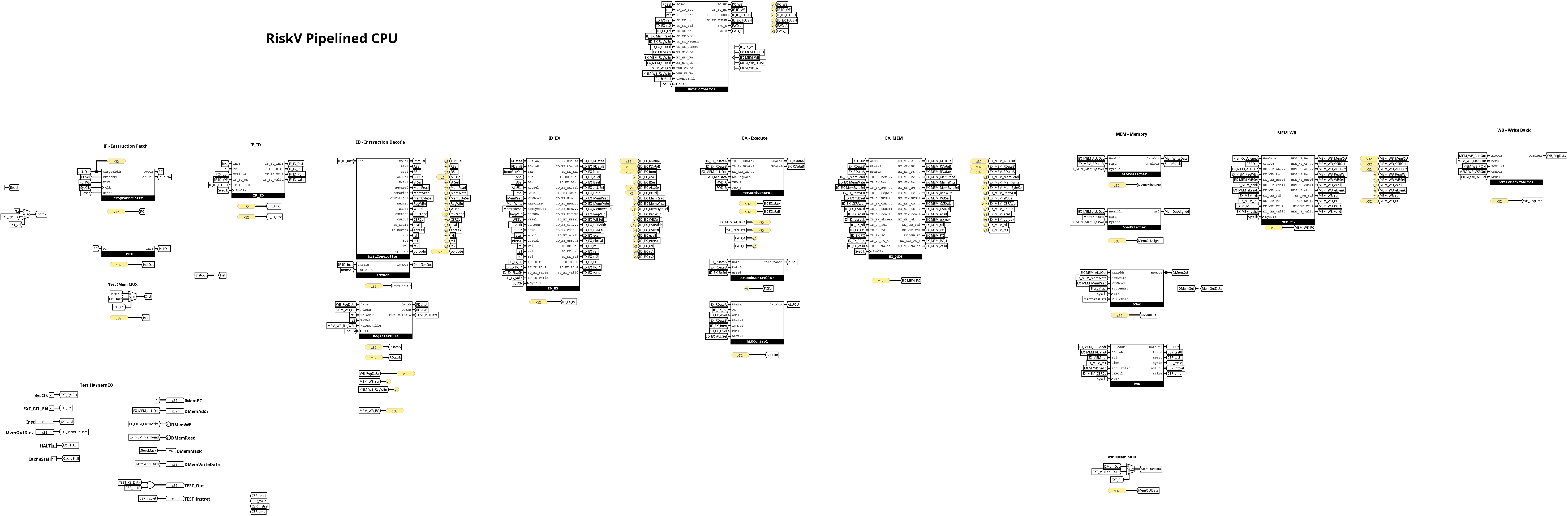
Risk-V is not a software project — it is a structural, educational microarchitecture study of a complete 5-stage pipelined RISC-V (RV32I) processor built in Logisim-evolution, a digital logic simulator. Every wire, every gate, and every pipeline register is visible and step-through-able.
The design covers the full classic 5-stage pipeline — Instruction Fetch, Decode, Execute, Memory Access, and Writeback — with hardware implementations of load-use hazard detection and stalling, operand forwarding (bypassing from EX/MEM and MEM/WB stages), and branch/jump resolution with pipeline flushes. An in-progress 4-way set-associative cache subsystem rounds out the memory hierarchy.
Complemented by a 22-page MkDocs Material documentation site and a Python-based automated test runner that validates 14 test suites against expected register state, the project is designed as both a reference implementation and a teaching tool.
Key Features
- Complete 5-stage RISC-V RV32I CPU: IF (Instruction Fetch) → ID (Decode + Register File) → EX (Execute + ALU) → MEM (Memory Access) → WB (Writeback)
- Hardware Hazard Controller: Formal boolean logic for load-use hazard detection —
LoadUseHazard = ID_EX_MemRead AND (ID_EX_rd != 0) AND (ID_EX_rd == IF_ID_rs1 OR ID_EX_rd == IF_ID_rs2)— triggering 1-cycle stalls with PC/IF_ID writes disabled - Operand Forwarding: Forwarding paths from EX/MEM and MEM/WB pipeline registers back to the ALU inputs, eliminating unnecessary stalls
- Branch and Jump Resolution: Control hazards handled with pipeline flushes when branches are taken; jump target computed in the Decode stage
- Full structural visibility: Every component built from Logisim primitives (AND/OR/NOT gates, multiplexers, registers) — no hidden abstractions
- 14 test suites: Automated testing via Logisim CLI covering alignment, branches, cache, control signals, CSR operations, pipeline flush behavior, multiply, and SLT instructions
- In-progress cache subsystem: 4-way set-associative cache with pseudo-LRU replacement, cache FSM with write-through/write-back policies
- RISC-V toolchain integration:
riscv64-unknown-elf-asassembler integration viacompile_logisim.shthat converts assembly listings to Logisim-compatible hex ROM files - Comprehensive documentation: MkDocs Material site with detailed write-ups on pipeline timing, hazard theory with truth tables, ALU control decoding, and component-by-component specifications
Architecture
CPU Datapath
┌─────────┐   ┌─────────┐   ┌─────────┐   ┌─────────┐   ┌─────────┐
│   IF    │──▶│   ID    │──▶│   EX    │──▶│   MEM   │──▶│   WB    │
│ PC+IMem │   │ Ctrl+RF │   │ ALU+Fwd │   │ DMem+Al │   │ WB Mux  │
└─────────┘   └─────────┘   └─────────┘   └─────────┘   └─────────┘
     │             │             │             │
  IF/ID reg     ID/EX reg     EX/MEM reg    MEM/WB reg
     │             │             │             │
     └──── Stall/Flush logic (Hazard Controller) ────┘
                       │
              Forward Controller ──┐
                       │           │ bypass paths
                       └───────────┘
Circuit Files
| Circuit | Contents |
|---|---|
RiskVCPU.circ | Top-level integrated 5-stage datapath |
RiskVControl.circ | Main control, hazard, forwarding, branch, immediate gen |
RiskVMemory.circ | Register File + Data Memory + load/store aligners |
RiskVALU.circ | ALU + M-extension multiplier/divider logic |
RiskVPipelineRegs.circ | IF/ID, ID/EX, EX/MEM, MEM/WB pipeline registers |
RiskVCache.circ | 4-way set-associative cache (in progress) |
Tech Stack
| Layer | Technology |
|---|---|
| Digital design | Logisim-evolution (Java-based logic simulator) |
| ISA | RISC-V RV32I (32-bit base integer instruction set) |
| Assembly | riscv64-unknown-elf-as (GNU assembler) |
| Test framework | Python 3 (scripts/test_runner.py), Logisim CLI |
| Documentation | MkDocs Material, Mermaid diagrams, MathJax |
| CI/CD | GitHub Actions (docs deploy on version tags) |
| License | MIT |